Book Binding, But Not the Way You Think!
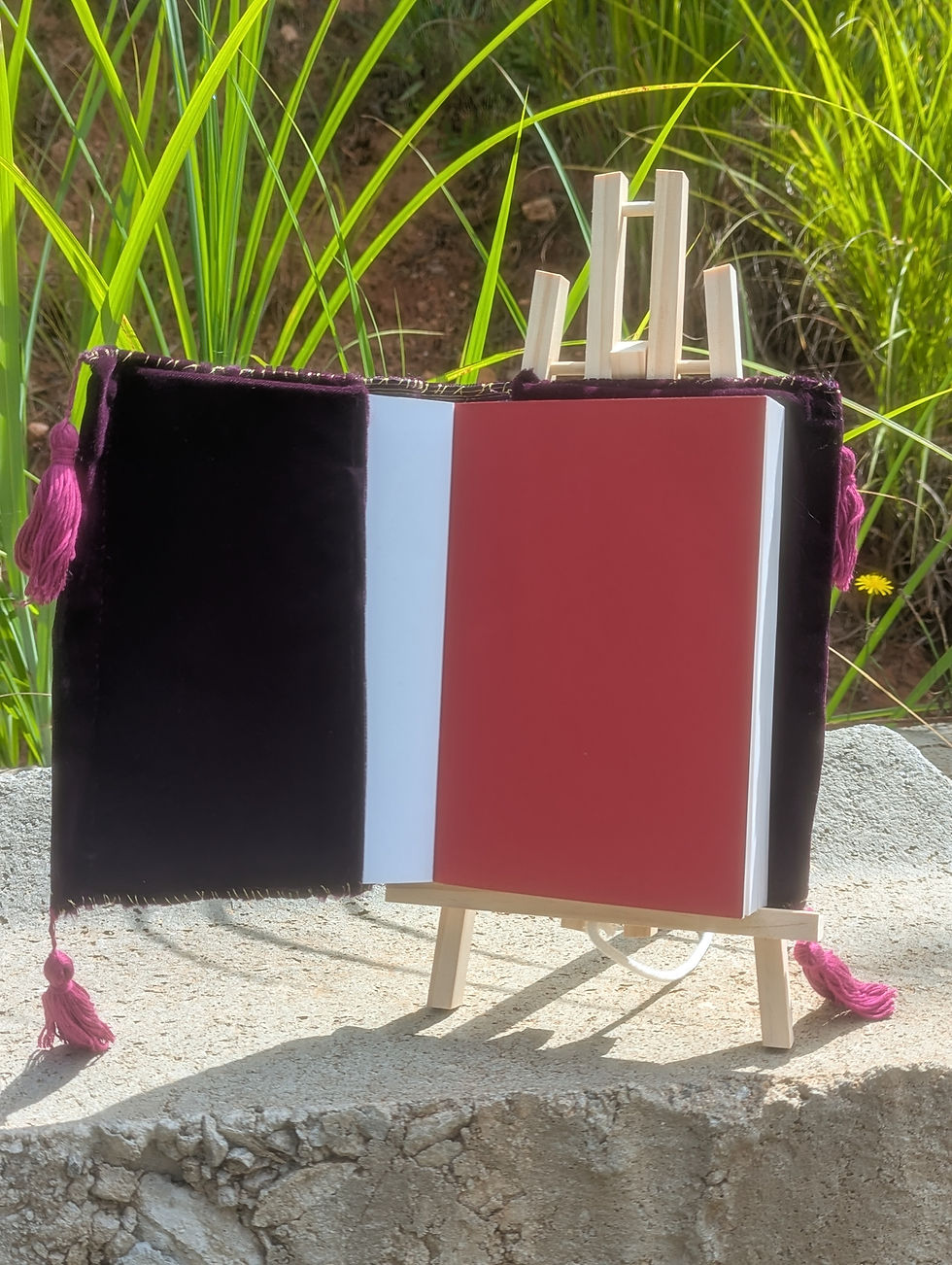
For the competition "The Ambassador's Gift" at the 2026 Hawkwood Baronial Birthday, I submitted a chemise book binding, complete with hand-stitched seams and goldwork embroidery. While it didn't win this competition, it did bring me great joy in researching and constructing it, and I plan to make more in the future once I've spent more time learning about the technique and taking my time with the stitching (I was in a rush to complete it because as always, I didn't give myself enough time...oops).
Tools and Materials
I chose my materials based on cost and accessibility of materials in the modern age.
Purple velvet fabric
Golden metallic embroidery thread
Metal embroidery needles
Assorted beads
Embroidery floss tassels
Project Background
This competition was a bit challenging for me. I did not know much about the Franco-Turkish alliance coming into this, nor much about either culture’s take on the arts and sciences during this period. After consulting online sources and learning a bit more about France and the Ottoman Empire from an embroiderer’s lens, I soon came across information on the subject of chemise book binding, and upon further exploration, I found that Francis I, one of the persons of interest in this competition and overall baronial birthday theme, significantly expanded the French royal library through his meticulous inventory of books. Among them were chemise-bound books, and from these findings, my project was born.
Historical Context: Francis I, “The Man of Letters”
During the reign of Francis I (1515-1547), the humanities in France flourished, undergoing a significant transformation in the arts, sciences, and literature. Upon his death, the town criers proclaimed, “Pray to God for the soul of […] the very Christian Francis, King of France by the Grace of God, the first of his name, a merciful prince and father to the arts and sciences.”1 A clear shift from the reign of Louis XII, Francis I was seen by humanist Guillaume Budé as a young ruler who would initiate an era where the bonæ litteræ (“good letters,” i.e. well-written books) would flourish.1
As stated previously, it was under Francis I that the royal library of France greatly expanded. “According to an inventory from 1518, 1,626 manuscripts and printed volumes belonged to the collection. Apart from religious texts, hunting manuals and medieval romances a number of classical texts in Latin were listed. During his reign, Francis added a number of volumes in Greek and Hebrew.”2 And with such a collection, one would think that surely the man couldn’t read all of those books by himself! And one would be correct. Francis was known to give rare books and manuscripts to family, scholars, and dignitaries alike, therefore it would not be unreasonable to assume that a book would be an appropriate diplomatic gift from Francis to foreign dignitaries including Suleimon I.
Historical Context: Chemise Book Coverings
So, what are chemise book coverings and what do they have to do with diplomatic gifts and Francis? Dating back as early as the 12th century, the chemise binding, or chemisette, was a form of book cover used as a secondary form of binding (i.e. a binding that covers an already bound book), it offered an additional layer of protection.”3 Though these coverings fell out of popularity in the mid-16th century, the cultural significance of them transcended centuries of literary history and preservation.
Popularized in Britain and France, these bindings are associated with the tradition of using drapery to hold, offer, and receive religious texts can be traced back to the Early Christian period4, as observed in the images below. Figure 15 depicts Odbert de Saint-Bertin and a scribe presenting manuscripts with covered hands, and figure 26 depicts an angel of the apocalypse addressing figures holding books with drapery hanging from the edges.

Figure 1

Figure 2
According to Bearman, “Monastic chemise coverings of animal skin and girdle bindings must have gone hand in hand with the idea of a devout life, not only for the clergy, but also for the officials of the royal courts and universities, whose own traditions and laws were rooted firmly in monastic ritual.”4 Culturally, however, there began a shift in the late 14th and early 15th centuries when Netherlandish artists turned these once great symbols of religious piety and reverence into objects of luxury and indicators of status.
During the 14th century onward in Britain, rich textiles such as velvets, silk brocades, and cloth of gold were used in royal circles to cover important manuscripts, and from the 15th century onward, velvet covers were often adorned with embroidery.7 One notable example is King Henry VIII’s Description of the Holy Land by Martin de Brion, circa 1540, as depicted in figure 3.
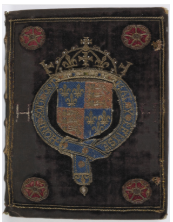
Figure 3: The armorial binding of Martin de Brion’s description of the Holy Land, dedicated to Henry VIII, England, ca. 1540. Purple velvet embroidered with silk and metal thread and pearls. British Library, London, Royal MS 20 A IV.8
Meanwhile in France, ornamental designs reflected trends of the era, with metallic threads and colorful silks creating a popular combination, as also witnessed in England.7 Now, circling back to our man of the hour, or man of the letters, rather, “Documentation of the prevalence of textile bindings is available in the detailed inventory made when the royal library at Blois, begun by Francois I moved to Fontainebleau. Of 1,859 volumes, 758 are fabric, of which 10 decorated with embroidery.”7 So again, it doesn’t seem far-fetched to me that Francis would gift a book, and particularly a book adorned in embroidery chemise binding, to foreign dignitaries including Suleiman I.
Now, one could spend an entire afternoon reading about the history of chemise bindings, and trust me, there is SO MUCH more information that I could give, but alas, the information above only serves to set the stage for my project. But I do highly encourage anyone interested in chemise book binding to go down that rabbit hole and have fun with it. All I am taking away from this is that I really want to make a girdle binding, which is a variation of chemise binding suited for another day, another project, another wordy documentation.
Process
Knowing where to start was probably the most challenging part of this whole process. Despite finding a plethora of photos of surviving bindings from online libraries, and historical drawing and paintings depicting them, there was also a notable lack of patterns. As an amateur sewist, I must have a pattern. So the first challenge was creating a binding without a pattern and simply following my intuition. I decided to loosely base my design off of King Henry VIII’s book binding pictured above in figure 3. I happened to have a scrap of purple velvet cloth.
Because I didn’t have a medieval-looking book or religious text on my bookshelf, I opted for the next best thing as depicted in figure 4: my Chinese version of Twilight. I used this book as the model for my pattern design. From here, I measured how much coverage I wanted my cover to have. From looking at various images of chemise bindings, I knew that the front and back cover were tucked into a pocket of sorts, so I folded the edges over into what I thought was adequate coverage (figure 5), and marked where I wanted to sew. From some of my readings on the topic, I found that often times these bindings incorporated large flaps on the edges to help protect the pages as well, so I modeled my pattern on that and created flappy edges as seen in figure 6.
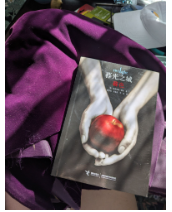
Figure 4
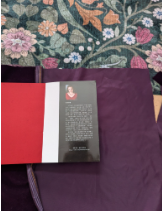
Figure 5

Figure 6
Wanting to be a little more historically accurate than I usually am (not very), I decided to hand sew the seams of this cloth instead of reverting to my very convenient, much faster modern sewing machine. From this project, I learned how to do a running back-stitch (figure 7), and also incorporated a whip stitch on my raw edges to help mitigate fraying (figure 8).
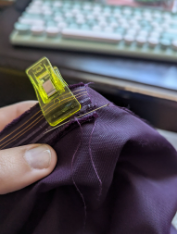
Figure 7

Figure 8
From here, I knew that I wanted to incorporate goldwork so my work can sparkle like the emo vampire it enveloped, and I also knew that I wanted to explore French motifs, therefore I took a very stylized version of a fleur-de-lis that I found online and decided to run with it. That was mistake numero uno. You see, I’m slow, like really slow when it comes to embroidery, and I did not give myself enough time to embroider this thing.Therefore, I fully admit that this is not my best work. The linework is sloppy and the couching is non-existent. I also added beadwork of alternating gold and purple, and adorned the edges with thread tassels, which was a common feature in historical chemise bindings.
Overall, I’m happy with myself for trying something new (hand sewing) and for finding a piece of history that may or may not be my new obsession. Seriously, these things are so cool!

Lessons Learned
TIME MANAGEMENT– I bit off a little more than I could chew with the size of the motif, especially during a very busy few weeks of my life. Sometimes, simpler is better.
Invest in goldwork tools. Just this week I learned what a mellor was… oops.
Citations
“A Model of a Humanist, Cultivated Prince: King Francis I of France | EHNE.” n.d. Ehne.fr. https://ehne.fr/en/encyclopedia/themes/humanism-enlightenment/humanism-rules/a-model-a-humanist-cultivated-prince-king-francis-i-france.
Medieval Histories, and Medieval Histories. 2015. “Francis I and His Library at Château de Blois.” Medieval Histories. August 18, 2015. https://www.medieval.eu/francis-i-and-his-library-at-chateau-de-blois/.
“Secondary Chemise Bookbinding Workshop | International Medieval Congress.” 2026. Leeds.ac.uk. 2026. https://www.imc.leeds.ac.uk/delegates/events/bookbinding-workshop/.
Bearman, Frederick. “The Origins and Significance of Two Late Medieval Textile Chemise Bookbindings in the Walters Art Gallery.” The Journal of the Walters Art Gallery 54 (1996): 163–87. http://www.jstor.org.lsus.idm.oclc.org/stable/20169116.
Library, Morgan. 2026. “Gospel Book, MS M.333 Fol. 84r - Images from Medieval and Renaissance Manuscripts - the Morgan Library & Museum.” Themorgan.org. 2026. https://ica.themorgan.org/manuscript/page/5/77221.
“Douce Apocalypse by MINIATURIST, English.” 2026. Www.wga.hu. 2026. https://www.wga.hu/html_m/zgothic/miniatur/1251-300/1english/59englis.html.
Design Commons, and Robin Muller. 2002. “Textile and Embroidered Bookbindings of Medieval England and France.” https://digitalcommons.unl.edu/cgi/viewcontent.cgi?article=1534&context=tsaconf
Welch, Katie. 2020. “HALI Book Review: Tudor Textiles - HALI.” HALI - HALI Magazine Is the Leading Publication in the World of Antique Carpets, Rugs, Textiles and Islamic Art. Hali Magazine Has Served the Needs of Dealers, Collectors and Art Lovers for over 20 Years. October 9, 2020. https://hali.com/news/hali-book-review-tudor-textiles/.


Comments